
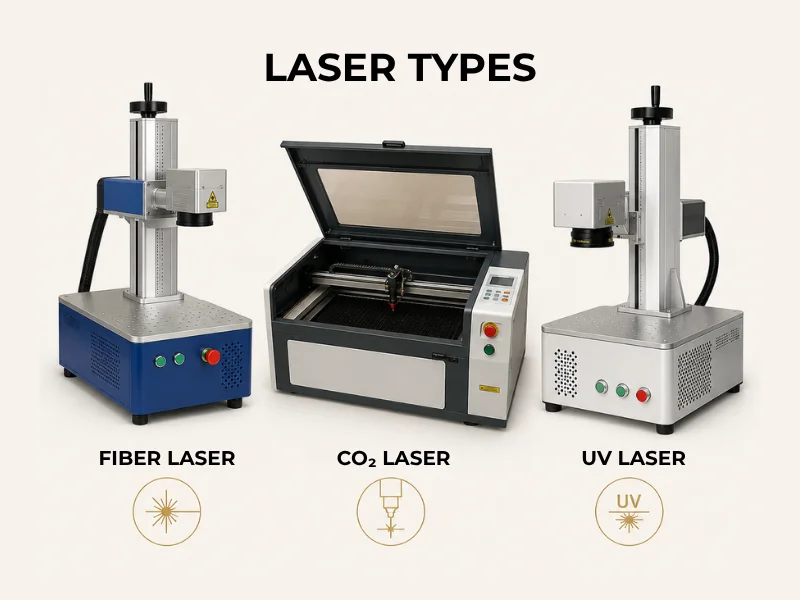
If you run a jewelry workshop or retail store, chances are you've been hearing about lasers everywhere lately. From engraving names inside rings to cutting delicate necklaces and repairing broken chains — laser technology has transformed the trade. But with three different laser types on the market — fiber, CO₂ and UV — how do you know which one is right for gold, silver and platinum work?
The short answer: not all three are equal for jewelry. In this article, we break it down simply, without drowning you in technical jargon.
What Is a Laser and Why Are There Different Types?
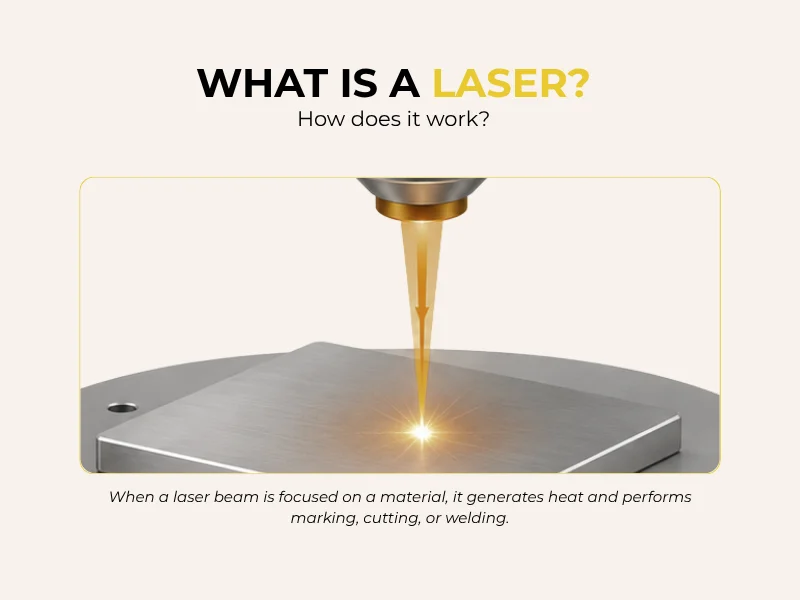
A laser is an extremely focused beam of light. When directed at a surface, it generates heat — enough to melt, vaporize or change the color of the material. That's how marking, cutting and welding are done.
So why three types? Because each laser operates at a different wavelength. Think of wavelength as a fingerprint that determines how well the light is absorbed by a given material. One material may absorb one wavelength perfectly while reflecting another entirely. Choosing the right laser for jewelry comes down to understanding this principle.
Fiber Laser: The Jeweler's First Choice
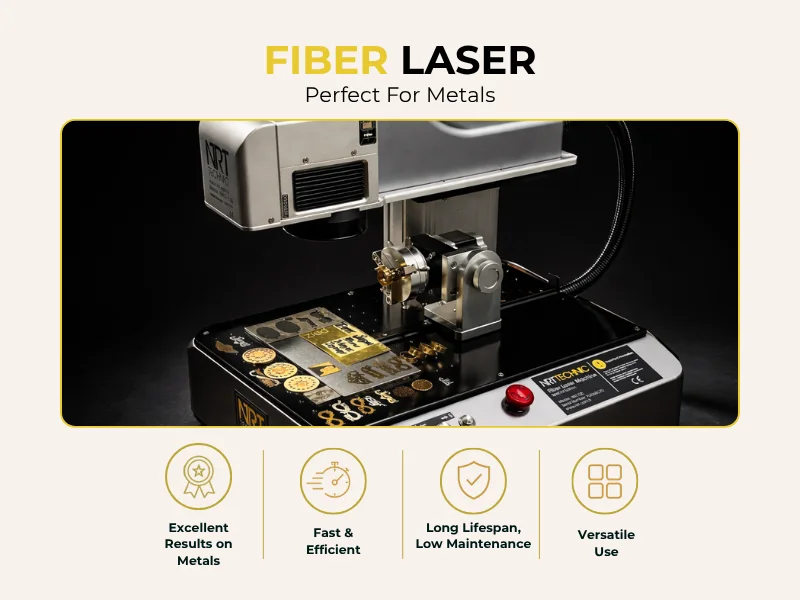
Fiber laser operates at 1064 nm — a wavelength that metals absorb exceptionally well. This makes it the most powerful option for metalwork by a wide margin.
Why jewelers prefer fiber laser:
- Outstanding results on metal: Leaves sharp, clean and permanent marks on gold, silver, platinum, stainless steel and copper.
- Speed: Marks in seconds — a major advantage in high-volume production.
- Long service life: Quality fiber sources reach ~100,000 hours MTBF. At 16 hours a day, that's roughly 17 years of operation.
- Virtually zero maintenance: No moving parts, no consumables to replace.
- Versatile: The same machine handles marking, engraving and fine cutting.
CO₂ Laser: Best for Wood and Packaging
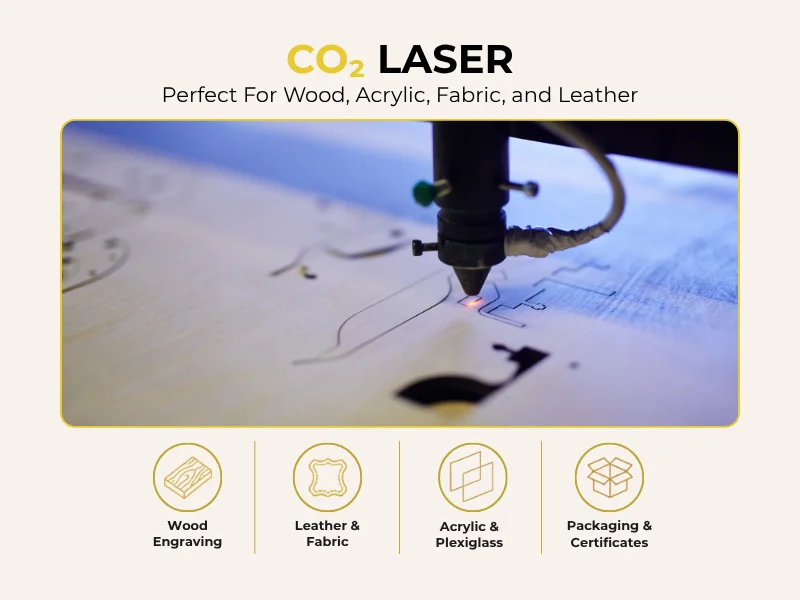
CO₂ laser operates at 10.6 µm — a wavelength that bare metal barely absorbs at all. Marking directly onto gold or silver with a CO₂ laser is practically impossible.
Where CO₂ excels: wood, acrylic, leather, paper, glass and fabric. For jewelers, it's useful for gift boxes, leather pouches and certificate cards — the presentation side of the business, not the metal itself.
UV Laser: Precision Cold Processing
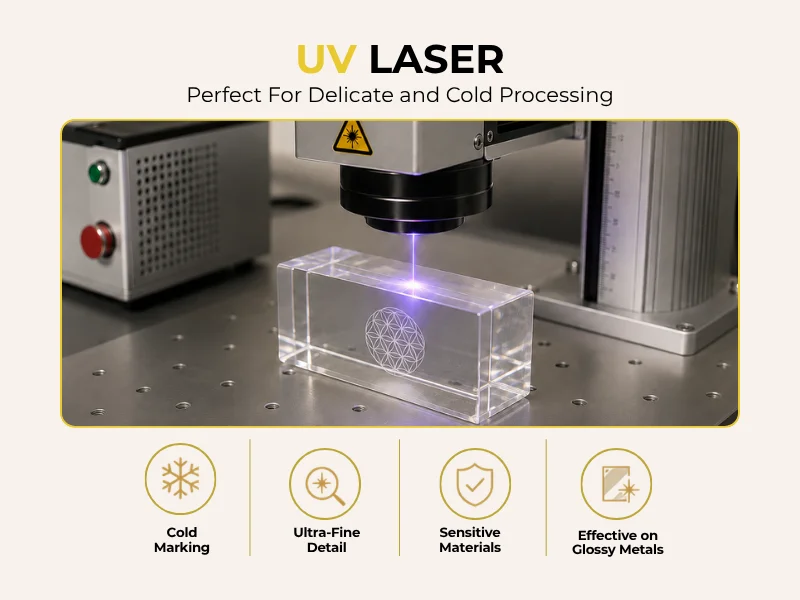
UV laser works at 355 nm and uses a technique called "cold marking" — it breaks chemical bonds directly rather than burning the material, so the heat-affected zone is minimal.
It shines on heat-sensitive materials like plastics, glass and silicone, producing extremely fine detail. However, for general jewelry work it's neither as fast nor as cost-effective as fiber laser.
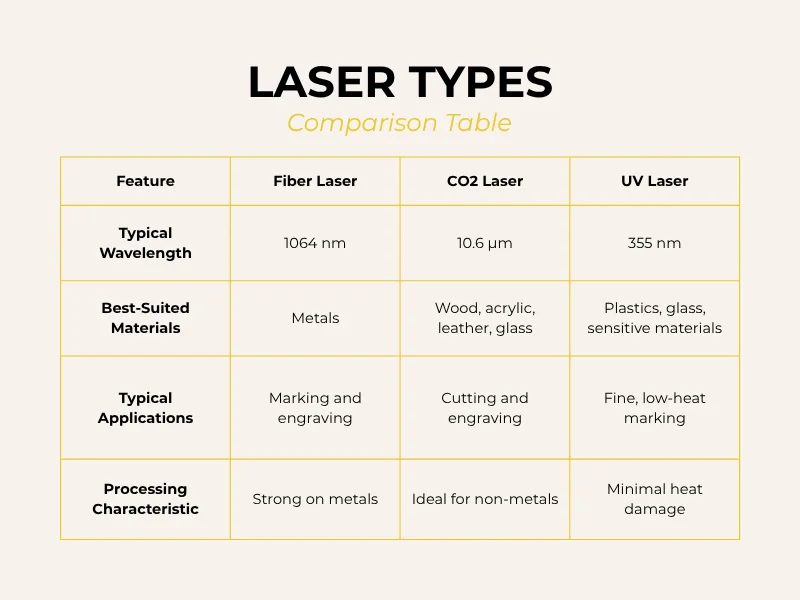
Comparison: Which One for Jewelers?
The table below summarizes all three laser types from a jewelry perspective. Fiber laser's dominance in metal processing is clear:
What Can You Do with Fiber Laser in Jewelry?
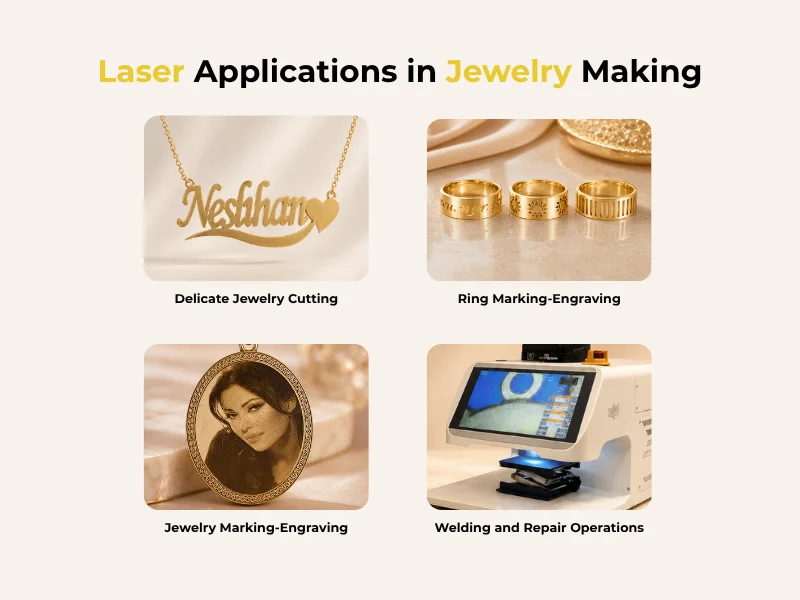
- Gold & Silver Marking / Engraving: Names, dates, logos, hallmarks (585, 925), serial numbers or QR codes — fast, permanent and sharp.
- Fine Cutting: Name necklaces, letters and figures from gold or silver sheet — less waste and far greater precision than traditional sawing.
- Ring Engraving: With a rotary axis (divisor), text can be engraved on the inside and outside of rings with ease.
- Repair & Welding: Broken chains, loose stone settings or ring sizing — precise welding without damaging surrounding pieces.
Choosing the Right Power: How Many Watts?
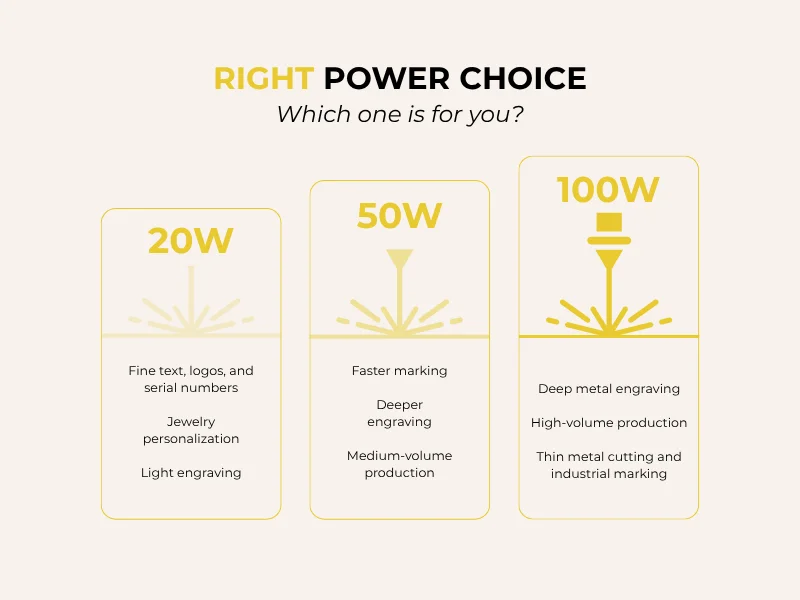
- 20W–30W: Surface marking, names and logos. Perfect entry point for small workshops.
- 50W: Both marking and fine cutting. The sweet spot for most jewelry businesses.
- 100W: Deep engraving and thicker sheet cutting. For high-volume production environments.
Frequently Asked Questions
Conclusion: NRT Technic's Fiber Laser Solutions
To sum up: if you're a jeweler, fiber laser is the technology at the heart of your daily work. CO₂ laser has its place for packaging and decorative materials, and UV laser serves highly specialized applications — but for gold, silver and platinum, fiber laser stands alone.
At NRT Technic, we have been manufacturing fiber laser marking & cutting machines tailored to the jewelry industry since 2012. Get in touch with our team to find the right model and power for your workshop.
Explore our fiber laser models and let's find the right fit together.
Our Fiber Laser Machines