
In the jewelry industry, precision is everything. Sometimes a crack a tenth of a millimetre wide, sometimes a single broken link in a fine chain can turn into a repair that takes hours. This is exactly where laser welding machines have become one of the goldsmith's greatest allies, in both repair and production.
So what exactly is laser welding in jewelry making, how does it work, and why is welding some metals harder than others? Let's take a closer look.
What Is Laser Welding?
Laser welding is the process of focusing a high-energy laser beam onto a very small spot on the metal, melting it and joining two parts together.
In classic soldering a wide area is heated, whereas in laser welding only the spot being welded is affected. The surrounding metal is not heated unnecessarily, the shape of the piece is preserved and the whole operation stays far more controlled.
Laser welding is now indispensable equipment in many jewelry workshops, especially for:
- Resizing rings up or down
- Chain repair
- Prong and claw repair
- Closing porosity
- Fixing small defects that appear during production
How Does a Laser Welding Machine Work?
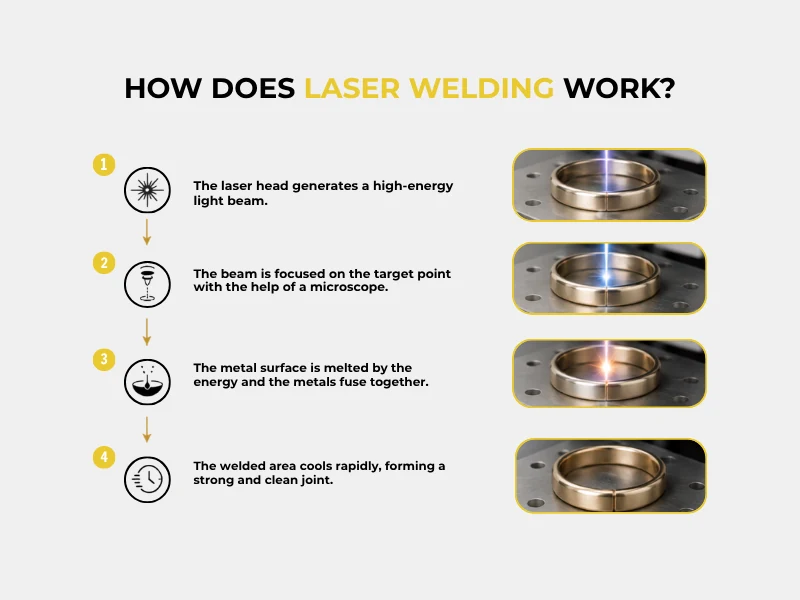
The working principle is actually quite simple. The laser beam produced by the machine is focused on the exact welding point with the help of a microscope or a CCD camera. Within just a few milliseconds the laser melts that tiny area and fuses the parts together.
Once the weld is complete, the molten zone solidifies again in a very short time and a solid joint is formed.
The biggest advantage is that the heat does not spread through the whole piece. This is a huge benefit when working on stone-set jewelry or delicate parts: less deformation, a cleaner weld and far less finishing work.
Which Metals Are Suitable for Laser Welding?
Laser welding machines deliver excellent results on many precious metals.
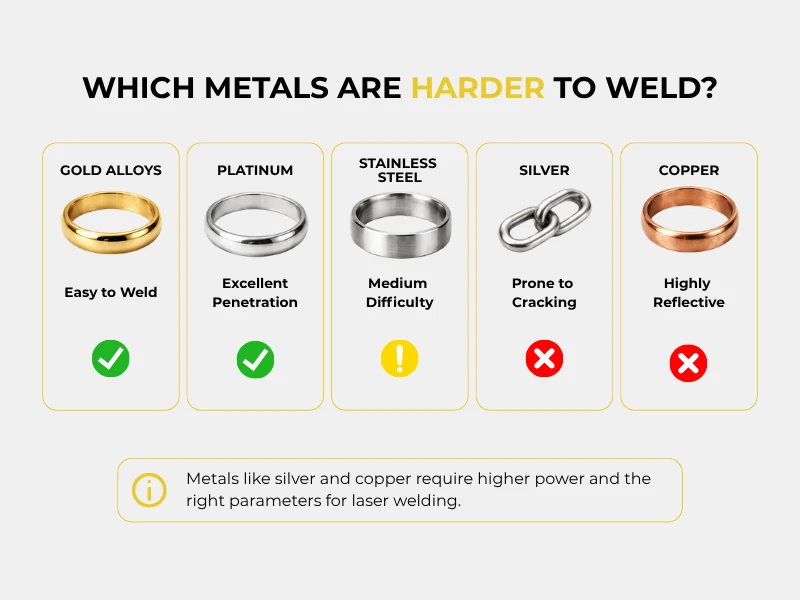
- Gold: One of the easiest metals to weld. With the right settings you get clean, aesthetic welds.
- Platinum and palladium: Despite their high melting points, they absorb laser energy very well and are often easier to weld than expected.
- Steel and stainless steel: Also well suited to laser welding.
But when it comes to silver and alloys with a high copper content, things change a little.
The reason lies in the relationship between the laser wavelength and the metal; if you want to read more about it, take a look at our article on the differences between fiber, CO₂ and UV lasers.
Why Is Silver Harder to Laser Weld?
The reason is not the machine — it is the physical nature of the metal.
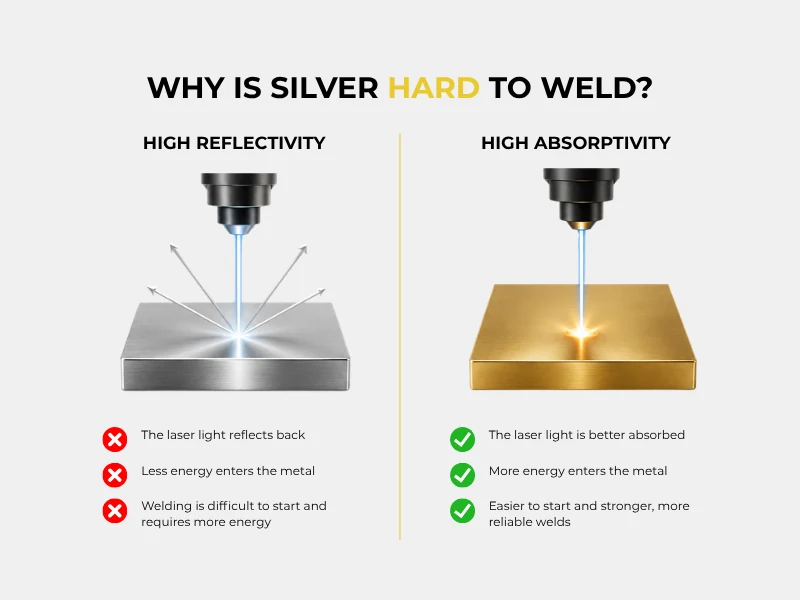
The simplest way to explain it: point a torch at a black wall and the light is largely absorbed by the surface. Point the same torch at a mirror and the light bounces straight back. Silver behaves almost like a mirror towards laser light.
Because it reflects a large part of the laser light, not enough energy enters the metal at the first pulse. On top of that, silver dissipates the heat it does absorb extremely quickly. In other words it both sends the energy back and refuses to hold it inside.
That is why, when welding silver:
- The weld starts late.
- Weld penetration can be reduced.
- Thick parts become harder to work on.
- Low-power machines do not always deliver the result you want.
Why Do We Recommend a 200 Watt Laser Welding Machine?
When choosing a laser welding machine for jewelry, looking only at the wattage is a mistake. Pulse settings, energy control, the optical system and the overall build quality matter just as much.
In practice, however, higher-power machines give a real advantage on reflective metals such as silver. That is why we recommend 200 Watt class laser welding machines wherever possible for workshops that work heavily with metals like silver.
Thanks to the higher power:
- The weld starts faster.
- Thick parts are much easier to handle.
- The reflection problem on silver and white gold is easier to overcome.
- Performance stays more stable during intensive all-day use.
For repair-focused businesses in particular, this difference saves serious time in the daily workflow.
A Small but Effective Workshop Tip
If you are working with a low-power machine, there is a practical trick that works especially well on bright silver and white gold.
Lightly colouring the area to be welded with a black permanent marker helps the laser light grip the surface, because a black surface does not reflect light the way polished metal does. The first laser pulse is absorbed more easily and the weld starts more readily.
What to Look for When Choosing a Laser Welding Machine
If you are thinking about buying a new machine, we recommend looking beyond the price tag and checking these points:
- Sufficient power capacity
- Precise power and pulse settings
- CCD camera or a high-quality microscope system
- Powerful water cooling system
- Stable laser output
- Technical service and spare part support
- A robust build that can run continuously for long periods
A good laser welding machine does not just produce better welds — it also takes a significant load off your daily work. Every one of these criteria is built into our NRT laser welding machines.
Frequently Asked Questions
Conclusion
Laser welding technology makes both repair and production processes in the jewelry industry far faster, more precise and safer.
Not every metal behaves the same way, but with the right machine, the right settings and the right technique it is possible to achieve excellent results on many metals — from gold to silver, from platinum to steel.
Choosing a machine with sufficient power is especially important for highly reflective metals such as silver: it produces better welds and makes the operator's job far easier.
Let's determine the right power for your workshop together — explore our laser welding machines.
Our Laser Welding Machines