
Where does melting loss come from? Most of the time the furnace is the first suspect. But the real loss does not always start there. How you heat the gold, how much control you have over the temperature and what happens to the metal while it melts matter at least as much as the furnace itself.
Where does melting loss come from?
In jewelry making gold and other precious metals are melted again and again, so losses that look small at first can add up to a serious difference over time.
That is why “how many kilos does it melt?” is not enough when you choose a gold melting furnace. Melting speed, temperature control, the way it is operated, capacity and the risk of melting loss have to be weighed together.
Why does melting loss happen?
The loss that occurs during melting can have several different causes:
- Overheating: when the alloy gets hotter than it needs to, metals such as zinc can be lost. That can shift both the total weight and the karat of the alloy.
- Oxidation: especially when melting with an open flame, the metal has more contact with air. Some metals in the alloy can oxidize and form slag.
- Remelting: when scrap and casting sprues are melted over and over, some of the metals in the alloy can be lost.
- Crucible and casting losses: metal can stay behind in a dirty or cracked crucible. Splashing during casting and metal left in the crucible add to the total loss as well.
So there is no single answer to the question “which furnace gives the least melting loss?”
Which gold melting furnaces are used in jewelry making?
The gold melting furnaces used in jewelry workshops differ considerably in the way they work. These are the options you come across most often:
- Melting gold with a torch
- Gas crucible furnace
- Electric resistance melting furnace
- Induction melting furnace
- Vacuum or inert gas induction systems
Let us look at the differences between them.
1. Melting gold with a torch
The torch has been used in jewelry workshops for many years and is practical especially for small quantities.
Propane-oxygen, natural gas-oxygen or hydrogen generator systems can be used. It is a common choice for melting a few grams of gold, for repair work and for small castings.
Its biggest advantage is simplicity. Temperature control, however, depends largely on the experience of the bench jeweler.
Because the flame touches the metal directly, the risk of oxidation and overheating can increase. As the quantity goes up, melting becomes more laborious.
2. Gas crucible furnace
In a gas melting furnace the flame does not heat the metal directly; it heats the crucible from the outside. It is still in use in some workshops that have a gas supply and work with larger quantities.
Set up correctly it does the job, but temperature control is not as precise as with induction systems.
In closed workshops the use of gas, combustion products and ventilation also have to be considered separately.
3. Electric melting furnace
When people say “electric melting furnace”, what is usually on the market is a resistance system.
In these systems the heating elements and the furnace chamber warm up first. The heat then passes to the crucible and the metal.
One of the main advantages is that it works without a flame and the temperature can be set on a thermostat.
But there is an important difference here: the metal is not heated directly. The furnace heats up first, then the heat reaches the metal. Melting can therefore take longer than with induction systems.
4. Induction melting furnace
The induction melting furnace is one of the systems that stands out in jewelry workshops that melt regularly.
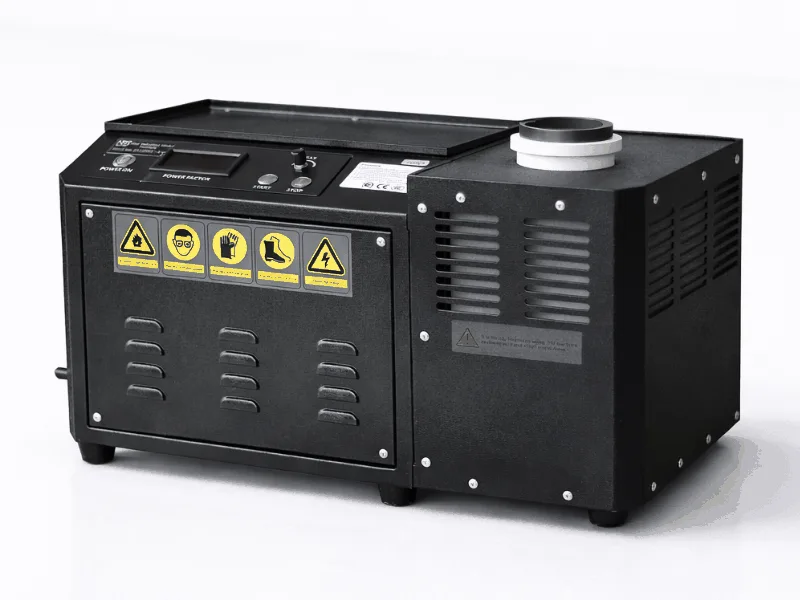
The fundamental difference here is that the metal is not heated from the outside. Thanks to the electromagnetic field the induction system creates, the heat is generated in the metal itself. So unlike classic resistance systems, there is no need to wait for the furnace to heat up first.
What does that mean for a jeweler? Faster melting and a more controlled process.
The induction system also moves the molten metal, which helps the alloy mix more homogeneously. That is a significant advantage especially when preparing alloys from several different metals.
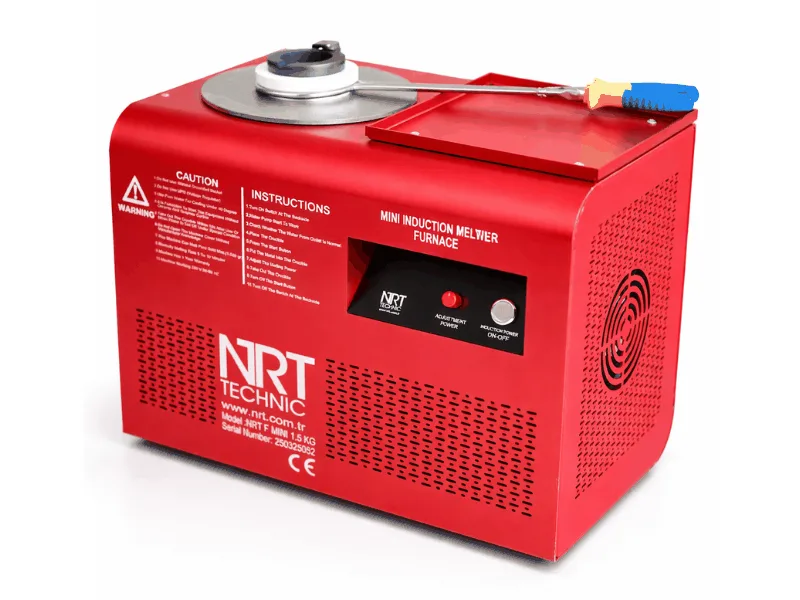
Today there are also benchtop mini induction melting furnaces that run on 220V, made for small workshops. The NRT model with 1.5 kg capacity runs on 220V and offers digital temperature setting between 950–1250°C.
5. Vacuum induction melting and casting machines
In vacuum systems induction melting is combined with a vacuum or an inert gas atmosphere.
Because the metal has less contact with air, oxidation and some of the problems that can occur during casting can be reduced.
These systems are designed above all for series production and more controlled casting processes.
For a small jewelry workshop that only wants to melt a few hundred grams or a few kilograms of metal, however, such a system can be a larger investment than necessary.
Gold melting furnace types compared
| Method | Melting speed | Temperature control | Risk of melting loss | Who is it for? |
|---|---|---|---|---|
| Torch | Fast for small amounts | Down to the operator | Higher | Repairs and small jobs |
| Gas crucible furnace | Medium | Limited | Medium to high | Large batches |
| Electric resistance | Slower | Thermostat | Medium | Budget-focused small workshops |
| Induction | Fast | Digital | More controlled | Regular melting and alloying |
| Vacuum induction | Fast | Precise | Low | Series casting production |
Which melting furnace suits a jeweler better?
The answer really depends on the way you work.
- If you melt gold a few times a month and in small amounts, a torch may do the job.
- If you melt every day but want to keep the initial investment low, an electric resistance melting furnace is worth considering. You do have to account for the waiting time melting requires.
- If you melt more than once a day, prepare gold or silver alloys and want a more controlled melting process, a mini induction melting furnace offers a different way of working.
- And if you run series casting production, vacuum induction casting systems are the ones to evaluate.
NRT Mini Induction Melting Furnace
Developed for small and medium-sized jewelry workshops, the NRT Mini Induction Melting Furnace is designed for melting metals such as gold, silver and copper.
The 1.5 kg model runs on 220V. The temperature can be set digitally between 950–1250°C and melting takes roughly 5–7 minutes. Its compact build means it can be used on the bench.
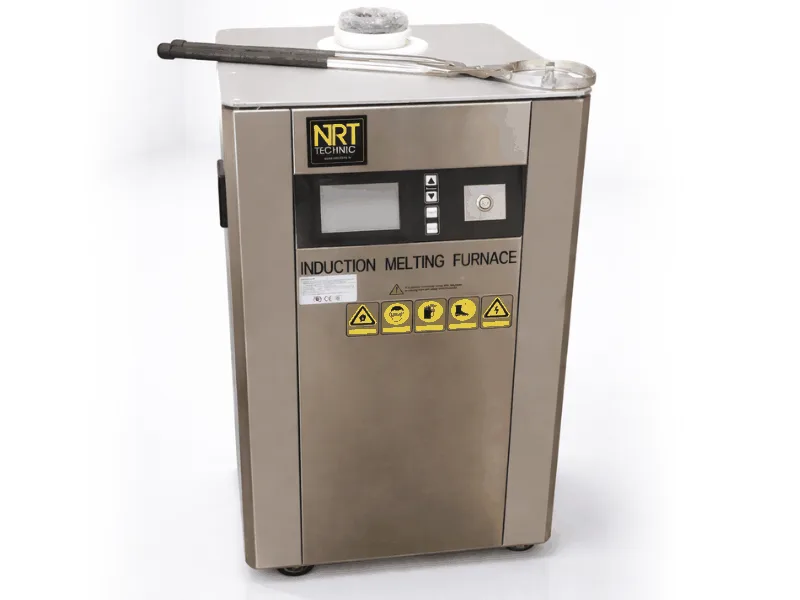
For workshops that need more capacity, NRT also offers 2 kg and 5 kg options. The 2 kg model runs on 220V and reaches up to 1450°C.
Let us work out together which capacity fits the melting routine in your workshop.
Frequently Asked Questions
Conclusion
Choosing a gold melting furnace cannot be reduced to a single “best” answer. A workshop that melts a few times a month and one that prepares alloys every day do not have the same needs, which is why the decision should be based on how often you work and how much temperature control you need before it is based on capacity.
Whichever furnace you choose, checking the karat before and after melting remains the most reliable way to keep track of melting loss.
Let us work out together which furnace fits the melting routine in your workshop.
Contact Us